Probability tells you how likely something is to happen. At GCSE Grade 4, you need to understand probability scales, calculate simple probabilities, and answer questions involving fractions, decimals and percentages.
The probability scale
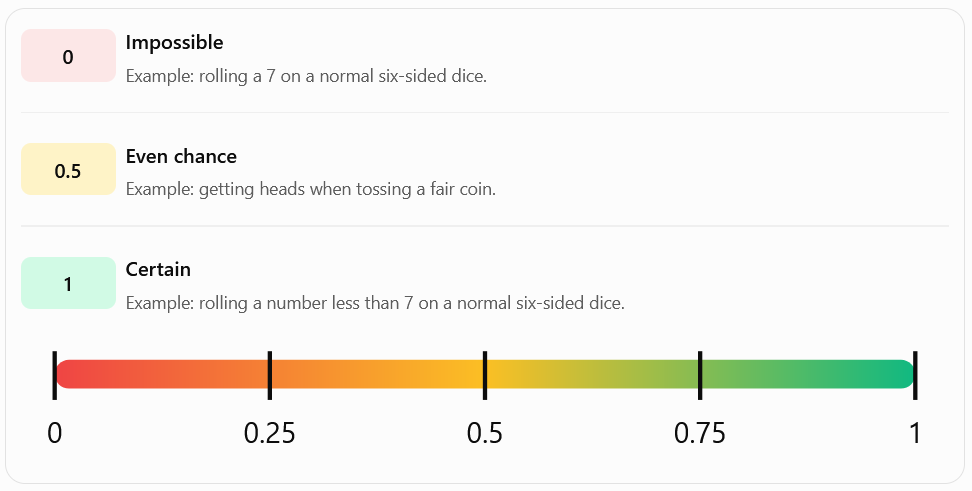
Remember: probability is always between 0 and 1, inclusive.
You can write probability as a fraction, decimal or percentage.
| Fraction | Decimal | Percentage |
|---|---|---|
| $0$ | 0 | 0% |
| $\frac14$ | 0.25 | 25% |
| $\frac12$ | 0.5 | 50% |
| $\frac34$ | 0.75 | 75% |
| $1$ | 1 | 100% |
Calculating probability
This is the most important formula to learn.
Probability =
\[ \frac{\text{Number of successful outcomes}}{\text{Total number of possible outcomes}} \]
Rolling a dice
A fair dice has six possible outcomes: 1, 2, 3, 4, 5 and 6.
Find the probability of rolling a 4.
Step 1: How many successful outcomes? There is only one 4.
Step 2: How many possible outcomes? There are six.
Step 3: Put them into the formula.
\[ P(4)=\frac16 \]
Answer: \[\frac16\]
Choosing a coloured ball
A bag contains 3 red balls, 5 blue balls and 2 green balls.
Find the probability of choosing a blue ball.
Step 1: Find the total number of balls.
\[ 3+5+2=10 \]
Step 2: Count the blue balls. There are 5.
Step 3: Calculate the probability.
\[ P(\text{blue})=\frac5{10}=\boxed{\frac12} \]
Always simplify your fraction if possible.
The probability of something NOT happening
Use this formula:
\[ P(\text{not } A)=1-P(A) \]
Example
The probability of catching a bus on time is $0.8$.
Find the probability that the bus is not on time.
\[ 1-0.8=\boxed{0.2} \]
The answer is 0.2, or 20%.
Remember: the probability of an event and the probability of it not happening always add up to 1.
Expected frequency
You may be asked how many times an event is expected to happen.
Use:
\[ \text{Expected frequency}=\text{Probability}\times\text{Number of trials} \]
Example
The probability of winning a game is $\frac14$. You play 80 times.
How many wins would you expect?
\[ \frac14\times80=\boxed{20} \]
You would expect to win 20 times.
This is an estimate, not a guarantee.
Mutually exclusive outcomes
Two events are mutually exclusive if they cannot happen at the same time.
For example, when rolling one dice, you cannot roll a 2 and a 5 on the same roll.
If you want the probability of getting a 1 or a 6:
\[ P(1\text{ or }6)=\frac16+\frac16 =\boxed{\frac13} \]
For mutually exclusive events, add the probabilities when the question says “or”.
Quick revision checklist
Before your GCSE exam, make sure you can:
- Identify impossible, even-chance and certain events.
- Calculate probability using successful outcomes divided by total outcomes.
- Simplify probability fractions.
- Calculate the probability of an event not happening.
- Find expected frequency by multiplying probability by the number of trials.
- Add probabilities for mutually exclusive events when the question asks for “or”.
Exam tip: If a question involves counters, cards or dice, write down the total number of possible outcomes first. This helps you avoid the most common mistake.