Reverse percentages are used when you know the final amount after a percentage increase or decrease and need to work out the original amount.
For example:
- A price increases by 20% to £60. What was the original price?
- A coat is reduced by 30% to £42. What was its original price?
The key rule is: divide by the percentage multiplier, not multiply by the percentage.
Understand the percentage multipliers
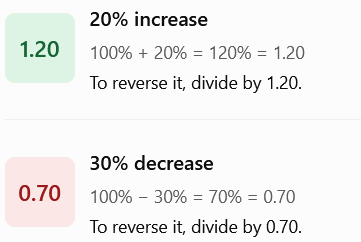
Remember:
- Percentage increase: add the percentage to 100%.
- Percentage decrease: subtract the percentage from 100%.
- Convert the resulting percentage into a decimal.
- Divide the final amount by that decimal.
Worked example 1: Percentage increase
A bicycle increases in price by 20% and now costs £360. Find its original price.
Step 1: Find the new percentage.
$100\%+20\%=120\%$
Step 2: Convert to a decimal.
$120\%=1.2$
Step 3: Divide the final price by 1.2.
\[ \text{Original price}=\frac{360}{1.2} \]
\[ \boxed{£300} \]
Check: 20% of £300 is £60.
£300 + £60 = £360. Correct!
Worked example 2: Percentage decrease
A television is reduced by 25% and now costs £450. Find its original price.
Step 1: Find the percentage remaining.
$100\%-25\%=75\%$
Step 2: Convert to a decimal.
$75\%=0.75$
Step 3: Divide the sale price by 0.75.
\[ \text{Original price}=\frac{450}{0.75} \]
\[ \boxed{£600} \]
Check: 25% of £600 is £150.
£600 − £150 = £450. Correct!
The exam tip to remember
| Question says… | What you do |
|---|---|
| Increased by 12% | Divide by 1.12 |
| Increased by 40% | Divide by 1.40 |
| Decreased by 15% | Divide by 0.85 |
| Decreased by 60% | Divide by 0.40 |
Common mistake: Do not simply subtract 20% from £240 to reverse a 20% reduction. The £240 already represents 80% of the original price.
The golden rule for GCSE Grade 5 is:
\[ \boxed{\text{Original amount}= \frac{\text{Final amount}}{\text{Multiplier}}} \]

Report a question
