Speed and density questions are about using formulas, rearranging them and making sure you use the correct units. At GCSE Grade 5, you should be able to calculate speed, distance, time, mass, volume and density.
Speed, distance and time
Speed tells you how far something travels in a certain amount of time.
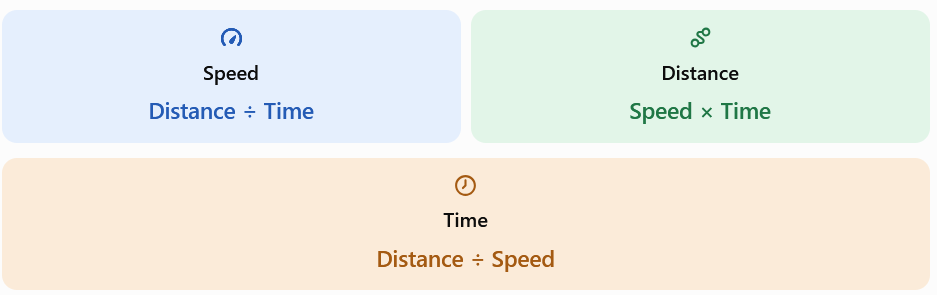
The three important formulas are:
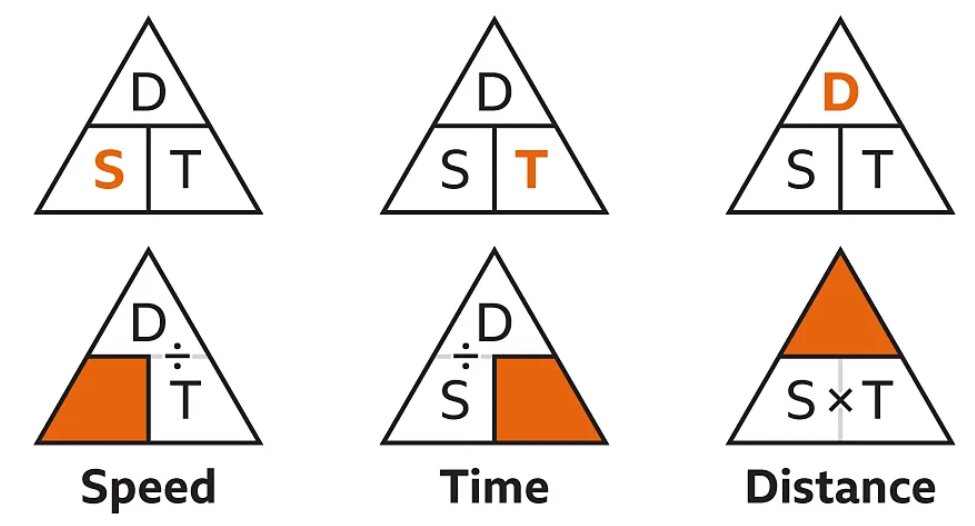
A useful way to remember the formulas is the speed triangle:
Cover the quantity you want to find:
- Cover Distance: multiply speed by time.
- Cover Speed: divide distance by time.
- Cover Time: divide distance by speed.
Example 1: Calculate speed
A car travels 150 km in 3 hours. Calculate its average speed.
Step 1: Write the formula.
\[ \text{Speed}=\frac{\text{Distance}}{\text{Time}} \]
Step 2: Substitute the values.
\[ \text{Speed}=\frac{150}{3}=50 \]
Answer: 50 km/h
Example 2: Calculate distance
A cyclist travels at 12 km/h for 2.5 hours. How far does the cyclist travel?
\[ \text{Distance}=\text{Speed}\times\text{Time} \]
\[ =12\times2.5=30 \]
Answer: 30 km
Example 3: Calculate time
A train travels 210 km at an average speed of 70 km/h. How long does the journey take?
\[ \text{Time}=\frac{210}{70}=3 \]
Answer: 3 hours
Converting units for speed
GCSE questions often require you to convert units before using a formula.
Remember:
- 1 hour = 60 minutes
- 1 minute = 60 seconds
- 1 km = 1000 metres
Example 4: A speed question with different units
A runner travels 400 metres in 80 seconds. Calculate the speed in metres per second (m/s).
\[ \text{Speed}=\frac{400}{80}=5 \]
Answer: 5 m/s
Converting between m/s and km/h
m/s Multiply by 3.6 to get km/h
km/h Divide by 3.6 to get m/s
For example, convert 20 m/s into km/h:
\[ 20\times3.6=\boxed{72\text{ km/h}} \]
Density, mass and volume
Density tells you how much mass is packed into a certain volume.
For example, a small block of metal may be heavier than a much larger block of wood because the metal is denser.
The formula is:
$\rho = \frac{m}{V}$
$\rho=\frac{\text{12}\,\mathrm{kg}}{\text{5}\,\mathrm{L}}=\text{2.4}\,\mathrm{kg/L}$
Where:
- Density measures mass per unit of volume.
- Mass is how much matter an object contains.
- Volume is the amount of space an object occupies.
Common units include:
| Quantity | Possible units |
|---|---|
| Density | g/cm³ or kg/m³ |
| Mass | g or kg |
| Volume | cm³ or m³ |
Example 5: Calculate density
A metal block has a mass of 240 g and a volume of 30 cm³. Calculate its density.
Step 1: Write the formula.
\[ \text{Density}=\frac{\text{Mass}}{\text{Volume}} \]
Step 2: Substitute the values.
\[ \text{Density}=\frac{240}{30}=8 \]
Answer: 8 g/cm³
Example 6: Calculate mass
A liquid has a density of 3 g/cm³ and a volume of 20 cm³. Calculate its mass.
Rearrange the formula:
\[ \text{Mass}=\text{Density}\times\text{Volume} \]
\[ =3\times20=60 \]
Answer: 60 g
Example 7: Calculate volume
An object has a mass of 150 g and a density of 5 g/cm³. Calculate its volume.
Rearrange the formula:
\[ \text{Volume}=\frac{\text{Mass}}{\text{Density}} \]
\[ =\frac{150}{5}=30 \]
Answer: 30 cm³
Exam tips
- Write down the correct formula before substituting numbers.
- Check whether the units match. Convert minutes to seconds if the answer needs to be in m/s.
- Rearrange the formula carefully when finding mass, volume, distance or time.
- Always include the correct units in your final answer.
- For density, make sure mass and volume use compatible units.
The key to Grade 5 is recognising which formula to use and rearranging it correctly.