These three topics are closely linked, and once you understand prime factorisation, HCF and LCM become much easier.
Prime factors
A factor is a number that divides exactly into another number. A prime number is a number greater than 1 that has exactly two factors: 1 and itself.
Some prime numbers to learn are:
Prime factorisation means writing a number as a multiplication of prime numbers only.
Worked example: Write 60 as a product of prime factors
The easiest GCSE method is a factor tree.
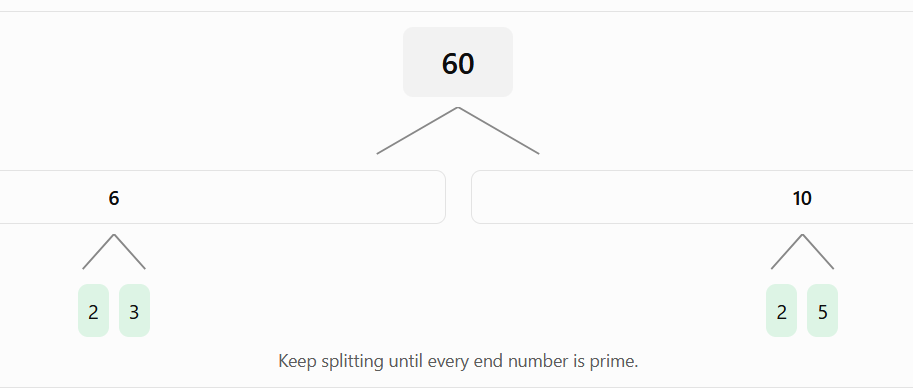
The prime numbers at the ends are 2, 2, 3 and 5.
Therefore:
Using index notation:
The means there are two factors of 2.
Exam tip: You must stop splitting a branch when you reach a prime number. For example, 9 is not prime because .
HCF — Highest Common Factor
The HCF is the biggest number that divides exactly into two or more numbers.
For example, the HCF of 12 and 18 is 6, because 6 is the largest number that divides into both.
Worked example: Find the HCF of 24 and 36
Step 1: Write both numbers as products of prime factors.
Step 2: Find the prime factors they have in common.
- Both have factors of 2.
- Both have factors of 3.
Step 3: Choose the lowest power of each common prime.
For 2, choose , because the lower power is 2.
For 3, choose , because has , but only has .
Step 4: Multiply them together.
The HCF rule
Choose only the common prime factors, using the lowest powers.
Think: What is the biggest number that goes into both numbers?
LCM — Lowest Common Multiple
The LCM is the smallest positive number that is a multiple of two or more numbers.
For example, the multiples of 4 are 4, 8, 12, 16, 20, 24…
The multiples of 6 are 6, 12, 18, 24…
The first multiple they share is 12, so the LCM is 12.
Worked example: Find the LCM of 24 and 36
We already know:
Step 1: List all the prime numbers needed.
We need 2 and 3.
Step 2: Choose the highest power of each prime.
- For 2, choose .
- For 3, choose .
Step 3: Multiply them together.
=8×9
The LCM rule
Choose every prime factor needed, using the highest power of each.
Think: What is the smallest number that both original numbers divide into exactly?Learn more
HCF vs LCM: How to remember the difference
| HCF | LCM |
|---|---|
| Highest Common Factor | Lowest Common Multiple |
| Use common prime factors only | Use all prime factors needed |
| Choose the lowest powers | Choose the highest powers |
| Example: HCF of 24 and 36 = 12 | Example: LCM of 24 and 36 = 72 |
A simple memory trick:
- HCF = Highest, Common, Fewest factors — use only what is shared.
- LCM = Lowest, Common, Multiple — include enough factors to cover both numbers.
Worded questions: an important GCSE skill
Sometimes the exam won’t directly say “find the LCM” or “find the HCF”. You need to work out which method to use.
- HCF example: You have 24 red sweets and 36 blue sweets. You want to make the greatest possible number of identical bags, with no sweets left over. How many bags can you make? Use the HCF: 12 bags.
- LCM example: One bus arrives every 12 minutes and another every 20 minutes. They arrive together now. When will they next arrive together? Use the LCM: 60 minutes.
Final revision checklist
Before your exam, make sure you can:
- Identify prime numbers.
- Draw a factor tree.
- Write prime factorisations using index notation.
- Find the HCF by choosing the lowest powers of common primes.
- Find the LCM by choosing the highest powers of all required primes.
- Recognise whether a worded question needs HCF or LCM.
The most important thing to remember: find the prime factorisation of each number first. Once you have those, HCF and LCM questions become much more straightforward.