Angles in parallel lines are a common GCSE Maths topic. The key is to learn three angle rules and recognise them in a diagram.
The three rules you need to know
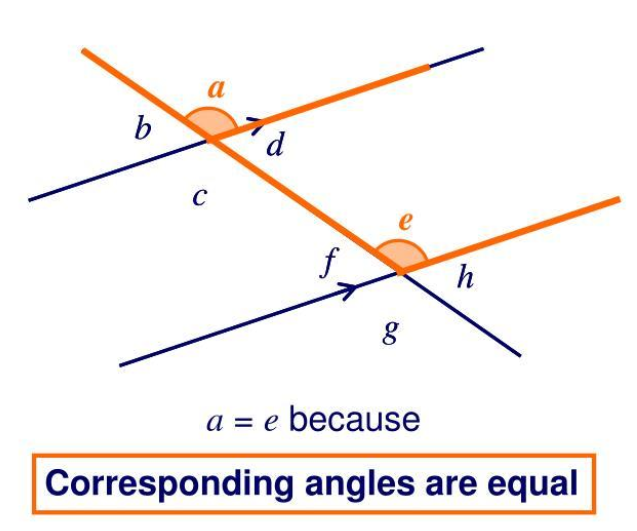
Rule 1: Corresponding angles are equal
F shape
If two parallel lines are crossed by another line, corresponding angles are equal.
Example: If one angle is $65^\circ$, its corresponding angle is also $65^\circ$.

Rule 2: Alternate angles are equal
Z shape
Look for a Z shape between the parallel lines.
Example: If one angle is $110^\circ$, its alternate angle is also $110^\circ$.

Rule 3: Co-interior angles add up to $180^\circ$
C shape
These angles are inside the parallel lines and on the same side of the crossing line.
Example: If one angle is $125^\circ$, the other is:
$180^\circ-125^\circ=\boxed{55^\circ}$
Two extra rules that help
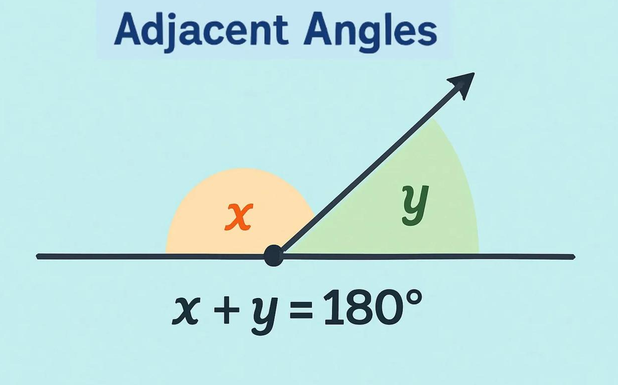
Angles on a straight line
They add up to $180^\circ$.
Example: $x+70^\circ=180^\circ$
\[x=\boxed{110^\circ}\]

Vertically opposite angles
Opposite angles where two lines cross are equal.
Example: If one angle is $48^\circ$, the opposite angle is $\boxed{48^\circ}$.
How to answer a GCSE exam question
Example question
Two parallel lines are crossed by a straight line. One angle is $68^\circ$. Find $x$, where $x$ is the co-interior angle on the same side of the crossing line.
Step 1: Identify the angle rule.
Co-interior angles add up to $180^\circ$.
Step 2: Write an equation.
$x+68^\circ=180^\circ $
Step 3: Subtract $68^\circ$.
\[ x=180^\circ-68^\circ \]
Answer:
\[ \boxed{x=112^\circ} \]
Exam tip: State the angle rule when showing your working, where possible.
Remember these for your exam
| Shape or position | Rule |
|---|---|
| F shape | Corresponding angles are equal |
| Z shape | Alternate angles are equal |
| C shape | Co-interior angles add to $180^\circ$ |
| Straight line | Angles add to $180^\circ$ |
| Opposite angles at a crossing | Vertically opposite angles are equal |
My top tip: Mark the F, Z or C shape on the diagram before calculating. This helps you choose the correct rule and earn marks even when the diagram looks complicated.