A polygon is a 2D shape with straight sides, such as a triangle, square, pentagon or hexagon.
The key to calculating angles in polygons is knowing how many sides the shape has and whether you need to find an interior angle, an exterior angle, or the sum of all the angles.
1. Learn the interior angle sum formula
The interior angles are the angles inside a polygon.
The formula for the sum of the interior angles is:
Here, is the number of sides.
For example, a pentagon has 5 sides:
So, the five interior angles of a pentagon add up to .
Interior angle sums to remember

Triangle — 3 sides, 180°
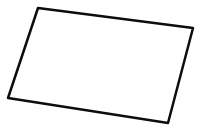
Quadrilateral — 4 sides, 360°

Pentagon — 5 sides, 540°

Hexagon — 6 sides, 720°
2. Calculate one interior angle in a regular polygon
A regular polygon has all sides equal and all interior angles equal.
To find one interior angle:
n(n−2)×180∘
Example: Find one interior angle of a regular hexagon.
Step 1: A hexagon has 6 sides, so .
Step 2: Calculate the total interior angle sum.
Step 3: Divide by the 6 equal angles.
Each interior angle is .
3. Calculate exterior angles
An exterior angle is formed by extending one side of the polygon. An interior angle and its adjacent exterior angle add up to 180∘.
For a regular polygon, you can also use:
For example, a regular pentagon has an exterior angle of:
Check: , since each interior angle is .
Remember: the exterior angles of any polygon add up to when you take one at each vertex in the same direction.
4. Find a missing angle
If a polygon is not regular, its angles might not all be equal. You can still find a missing angle by subtracting the known angles from the total.
Example: A quadrilateral has three angles of , and . Find the fourth angle.
Step 1: The interior angles of a quadrilateral add up to 360∘.
Step 2: Add the known angles.
Step 3: Subtract from 360∘.
The missing angle is .
Quick formula sheet
| What you need to find | Formula |
|---|---|
| Sum of interior angles | (n−2)×180∘ |
| One interior angle in a regular polygon | n(n−2)×180∘ |
| One exterior angle in a regular polygon | n360∘ |
| Interior angle from an exterior angle | 180∘−exterior angle |
| Missing interior angle | Total sum minus known angles |
Exam tip: First count the sides, then identify which type of angle you need. That tells you which formula to use.