Loci and constructions is a topic where you use a ruler, a pair of compasses and sometimes a protractor to draw accurate diagrams and find positions that satisfy certain rules.
Let’s go through the key ideas step by step.
What is a locus?
A locus (plural: loci) is a set of points that follow a particular rule.
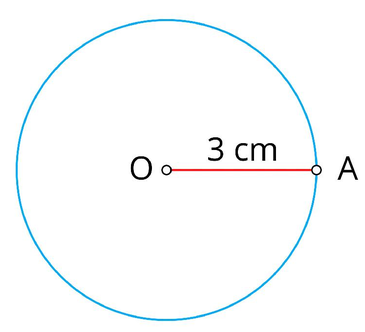
For example, imagine you want to find every point that is exactly 3 cm away from point A. All those points form a circle.
There are four main types of locus you need to know for GCSE.
The four important loci

Rule 1: A fixed distance from a point
The locus is a circle centred on the point.
Example: Draw all points 3 cm from A.
Use your compasses set to 3 cm and draw a circle centred at A.

Rule 2: Equidistant from two points
The locus is the perpendicular bisector of the line joining the two points.
Example: Find all points the same distance from A and B.
Draw a line at 90° through the midpoint of AB.
Rule 3: Equidistant from two lines
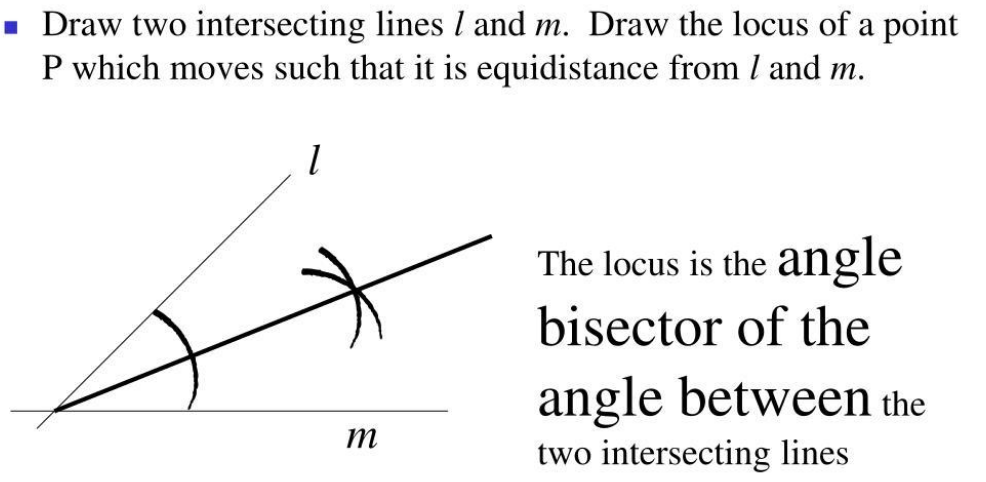
The locus is an angle bisector.
Example: Find all points the same perpendicular distance from two intersecting roads.
Bisect the angle between the two lines.
Rule 4: A fixed distance from a straight line
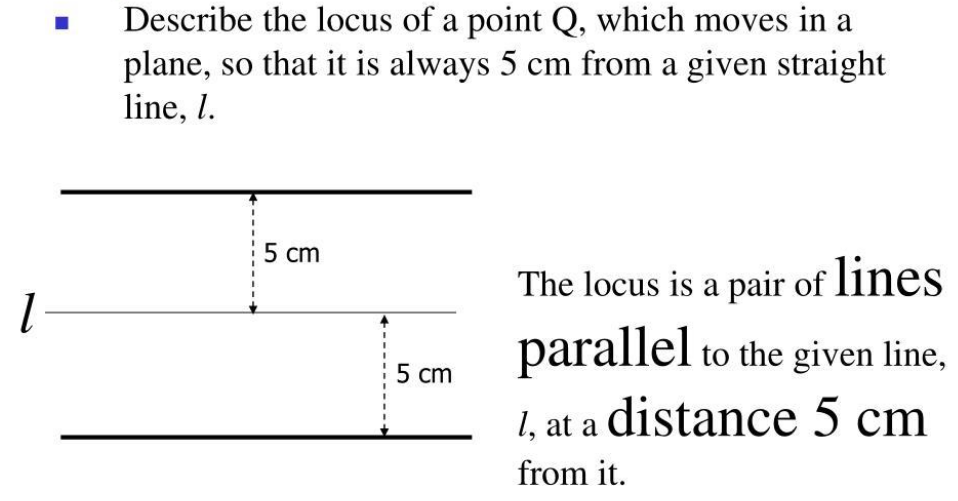
The locus consists of two parallel lines, one on each side of the original line.
Example: Find all points 2 cm from a straight road.
Draw parallel lines 2 cm away on both sides.
How to construct a perpendicular bisector
A perpendicular bisector cuts a line into two equal halves at 90°.
Example: Construct the perpendicular bisector of AB.
1
Draw the line AB.
Place your ruler between A and B.
2
Open your compasses to more than half the length of AB.
Put the compass point on A and draw an arc above and below the line.
3
Repeat from B using the same compass width.
Your new arcs should cross the first pair of arcs.
4
Join the two arc intersections with a ruler.
This is the perpendicular bisector.
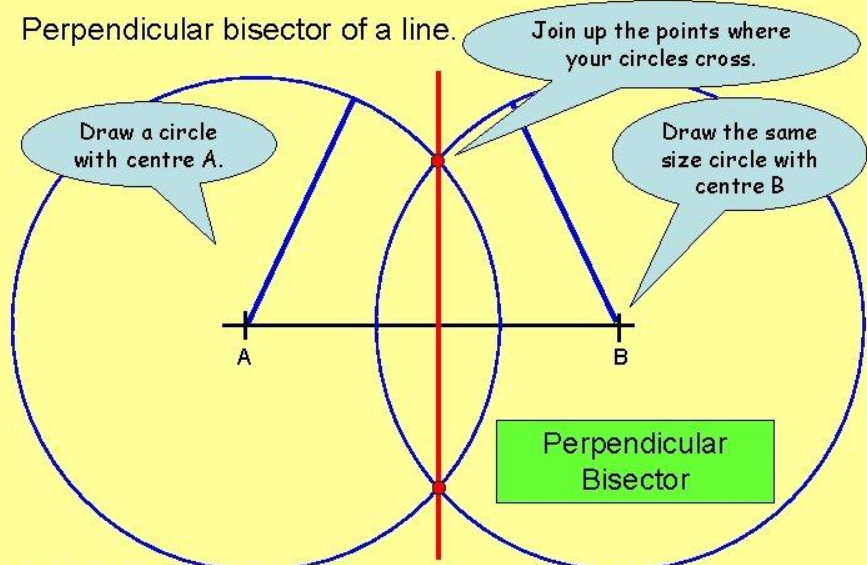
Exam tip: Keep the compass width the same when drawing arcs from A and B. You do not need to measure the midpoint.
How to construct an angle bisector
An angle bisector splits an angle into two equal angles.

How to answer GCSE shaded-region locus questions
These questions often combine two or three rules.
For example:
A question says:
- Draw all points within 4 cm of point A.
- Draw all points closer to A than to point B.
- Shade the region that satisfies both conditions.
Here’s how to approach it.
- Draw a circle centred at A with radius 4 cm.
- Construct the perpendicular bisector of AB.
- Identify the side of the bisector closer to A.
- Shade only the area that is both inside the circle and on the correct side of the bisector.
Remember these keywords:
| Exam wording | What you draw |
|---|---|
| Within 3 cm of A | Inside a circle of radius 3 cm |
| More than 3 cm from A | Outside a circle of radius 3 cm |
| Equidistant from A and B | Perpendicular bisector |
| Equidistant from two lines | Angle bisector |
| Within 2 cm of a road | Parallel boundaries 2 cm away |
| Closer to A than B | The side of the perpendicular bisector containing A |
Important: If the question says within a distance, the boundary is usually included. Follow any instructions about solid or dashed lines in the question.
Final revision tip
For GCSE Grade 4, concentrate on recognising the correct locus, using a compass accurately, constructing perpendicular and angle bisectors, and shading the correct region. Always leave your construction arcs visible, as they can help you earn method marks.